
Seasonal Gate Maintenance for Swing and Sliding Gates
A simple routine that keeps a driveway or lot gate moving through freeze-thaw, snow and road salt, with a planner for your own task list.
A gate rarely fails all at once. Grit builds up in a track, a hinge runs dry, a post leans after a hard frost, and one day the gate stalls halfway. A short check each season catches most of that while the fix is still small.
Winter is the hard part here. Freeze-thaw moves posts and pavers, plow banks press against closed gates, and road salt eats at steel. The planner builds a list for your gate, and the sections after it explain each job.
Build Your Gate Task List
Pick your gate and opener, then press the button for a list of tasks by season that you can print.
Choose your gate and opener, then press Make My Task List.
Season-by-Season Checklists
These suit most home and small business gates. Skip the opener items if you open your gate by hand.
Spring
- Walk the fence line after the thaw and look for posts that lean or have lifted.
- Rinse the winter’s salt off the frame, hinges or wheels, and the latch.
- Test the opener’s safety sensors and auto-reverse.
Summer
- Touch up chips and rust spots while the weather is dry.
- Tighten loose bolts on hinges, brackets and latches.
- Trim plants away from the gate’s path, the sensors and the keypad.
Fall
- Clear leaves from the track or swing path before snow packs them down.
- Lubricate hinges and pivot points before the cold.
- Mark the gate’s edges with tall stakes so a plow driver can see them.
Winter
- Clear snow from the whole area the gate moves through after each storm.
- Keep plow banks off the gate and out of a slider’s side run.
- Thaw a frozen gate rather than forcing it with the opener.

Maintenance Tasks and How Often
Some of this is quick work for the owner. Some of it needs parts or a trained eye.
| Task | How often | Owner or professional | Why it matters |
|---|---|---|---|
| Clear the track or swing path | Weekly in fall and winter | Owner | Grit, leaves and ice are the usual reasons a gate drags or stalls. |
| Rinse salt off the frame and hardware | After salty spells, and each spring | Owner, with a hose | Road salt speeds up rust on steel, hinges and wheels. |
| Lubricate hinges and pivot points | Late spring and fall | Owner | Dry hinges wear faster and make an opener work harder. |
| Test the safety sensors | Monthly on an automatic gate | Owner tests; a professional fixes a fault | A gate that does not stop for its sensors can hurt people, pets and cars. |
| Check posts, hinges and wheels for wear | Each spring, after the thaw | Owner looks; a professional resets or replaces | Frost heave and worn parts pull a gate out of line. |
| Service the operator and control board | Once a year | Professional | Loose wiring, worn gears and weak batteries show up before they fail. |
Cleaning and Lubricating a Gate Track or Hinges
Safety First
An automatic gate can start moving while your hands are in a hinge or track. Switch the opener off and put it in manual before you touch anything.
- Switch the opener off and put it in manual. Turn off its power, then use the manual release so the gate moves only by hand.
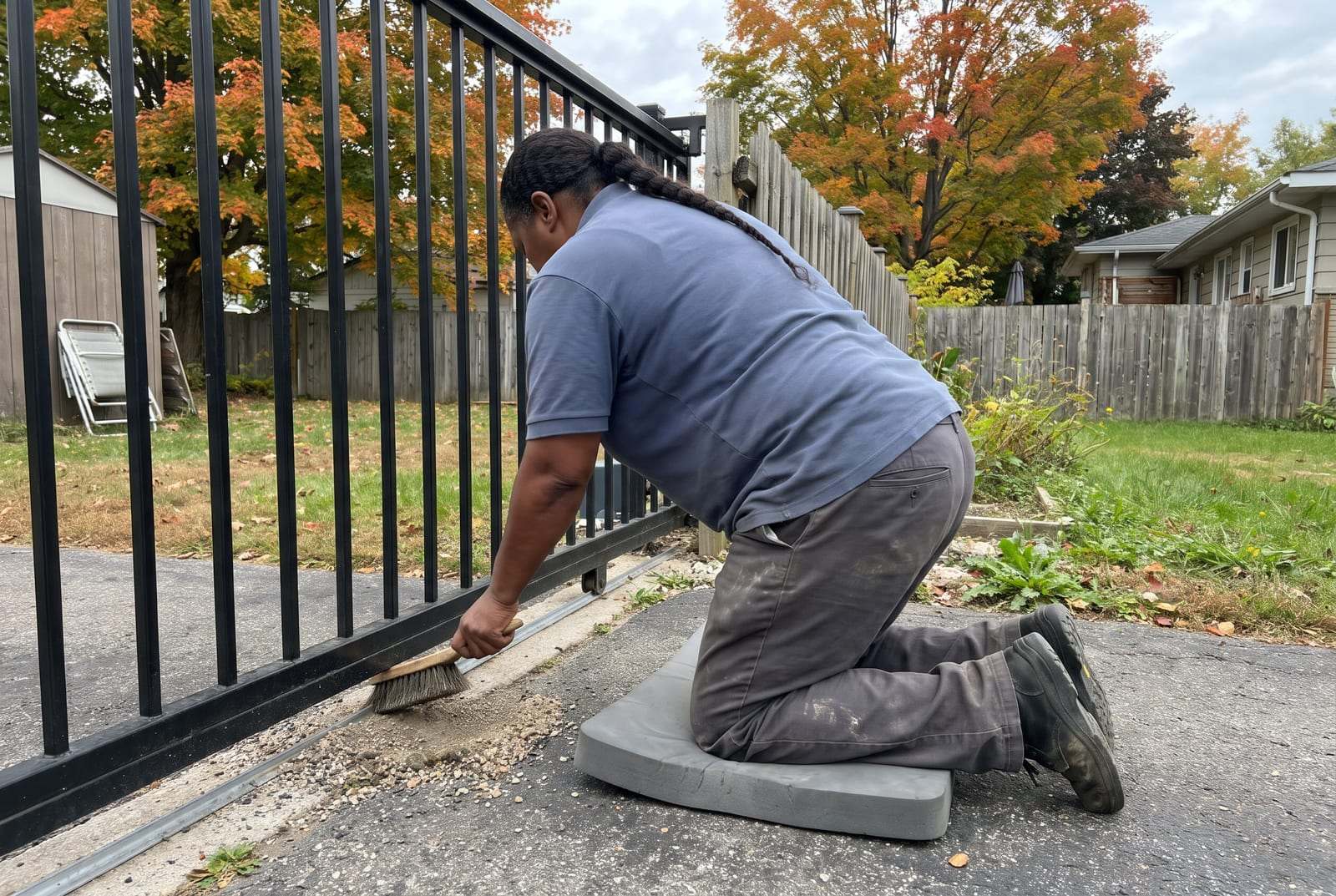
- Clear the dirt. Sweep a slide track with a stiff brush and pick out stones. On a swing gate, brush grit and old grease off the hinges.
- Lubricate only the parts that turn. Hinges, pivot points and roller axles take a light coat. Leave the slide track clean and dry.
- Wipe off the extra. Drips on the frame or track collect dirt.
- Run the gate by hand. It should move smoothly through its full travel, with no scraping or binding.
- Put the opener back in automatic. Turn the power on and stand clear while you watch one full cycle.
Clearing Snow and Ice Safely Around the Gate
A plow bank left against a closed gate can bend its frame, and ice in its path makes an opener strain.
- Switch an automatic gate off or to manual. Nobody can then start it with a remote while you are in its path.
- Clear the whole path. That means the full arc of each swing leaf, or a slider’s track and the side run where it parks.
- Use a plastic shovel near the gate. Metal blades chip coatings, and chips are where rust starts.
- Break ice gently. Tap it out of a track or drop-rod hole with a plastic scraper. Never pry the gate.
- Go easy on salt. Keep ice melt off the gate and out of the track.
- Test before you drive through. Brush off the photo eyes, switch back to automatic and run one full cycle.
Questions About Gate Maintenance
What should I use on hinges and slide tracks?
Hinges, pivot points and roller axles take a light coat of lubricant made for outdoor metal, wiped afterward. A slide track is different: keep it clean and dry rather than greased, because grease holds grit and grinds it into the wheels.
How much damage does road salt do to a gate?
Over a few winters, quite a lot. Salt spray settles on the lower frame, hinges and wheels, and gets in first wherever the coating is chipped. Rinsing in winter and spring and touching up chips in summer slows it down.
Does my opener need a battery backup?
Not every gate needs one, but it helps where the gate is the only way in or out. Batteries lose strength in the cold and wear out with age, so test yours each fall. Without a backup, the manual release lets you move the gate by hand.
When should I book a professional check?
Once a year suits an automatic gate, and spring is a good time because winter damage shows by then. Call sooner if the gate drags, stalls, leans or stops reversing for its sensors. Tell us what it is doing and we will arrange a time to come take a look.
If a seasonal check turns up a sagging hinge, a worn wheel or an opener that will not reverse, call and we will come take a look.