
Gate Questions and Answers
The questions customers ask us most about gates, openers, entry systems, winter care and booking a visit, grouped by topic.
These are the questions we hear most from homeowners, landlords, property managers and small businesses. They are grouped by topic, so you can jump straight to the one you need. If your question is not here, call us and ask.
Repairs and Problems
Why does my swing gate sag and drag on the drive?
Usually the hinges have worn or worked loose, or the hinge post has leaned under the gate’s weight. In clay soil, frost can lift a post out of line over a winter. Resetting or replacing the hinges and straightening the post brings the gate back up.
My sliding gate grinds and jerks along the track. What causes that?
Worn rollers or wheels, grit packed into the track, or a section of track that has bent. A sliding gate should roll smoothly and quietly; grinding means metal is wearing on metal, and it gets worse the longer it runs.
The latch no longer lines up. Can it be adjusted?
Often, yes. A latch that stops catching is usually a sign the gate has sagged or a post has shifted, so the cause gets fixed first and the latch is realigned to match.
Can a gate that a car hit be repaired?
It depends on how far the frame, the hinges and the posts have moved. A bent hinge or a knocked sensor is a part. A frame bent out of square, or a post pushed over, may mean straightening or new parts.
Why does my gate rattle or bang in the wind?
Loose hinges, worn guide rollers or a missing gate stop let the gate move when it should sit still. The knocking wears the parts faster, so it is worth fixing before something breaks.
More on hinge, roller, track and wiring work on the gate repair page.
Openers and Power
Does a swing gate need a different opener from a sliding gate?
Yes. Swing gates use an arm or a straight actuator on the gate, or an operator set under the ground at the hinge. Sliding gates use an operator beside the opening that drives the gate along, most often with a toothed rack fixed to the gate.
Why does the opener run but the gate does not move?
Often the manual release has been left open, so the motor turns without driving the gate. Other causes are a broken arm bracket, worn gears, or a gate frozen or jammed in place. If the release is locked and the gate still sits still, switch it off and call.
Can I set the gate to close by itself after a car goes through?
Most operators have an auto-close timer that closes the gate after it has stood open for a set time. It should only be used with working photo eyes or other safety devices, so the gate cannot close on a car or a person.
What does a battery backup do?
It keeps the opener working for a limited number of cycles when the power goes out. How many depends on the battery and the gate. Without one, the gate stays where it stopped until you use the manual release.
Why is my opener getting louder?
A new grinding or straining sound often comes from worn gears, or from a gate that drags and makes the motor work harder. Noise is an early warning, and the fix is usually smaller if it is looked at early.
Replacing or upgrading an operator is covered on the gate openers page.
New Gates and Choosing Options
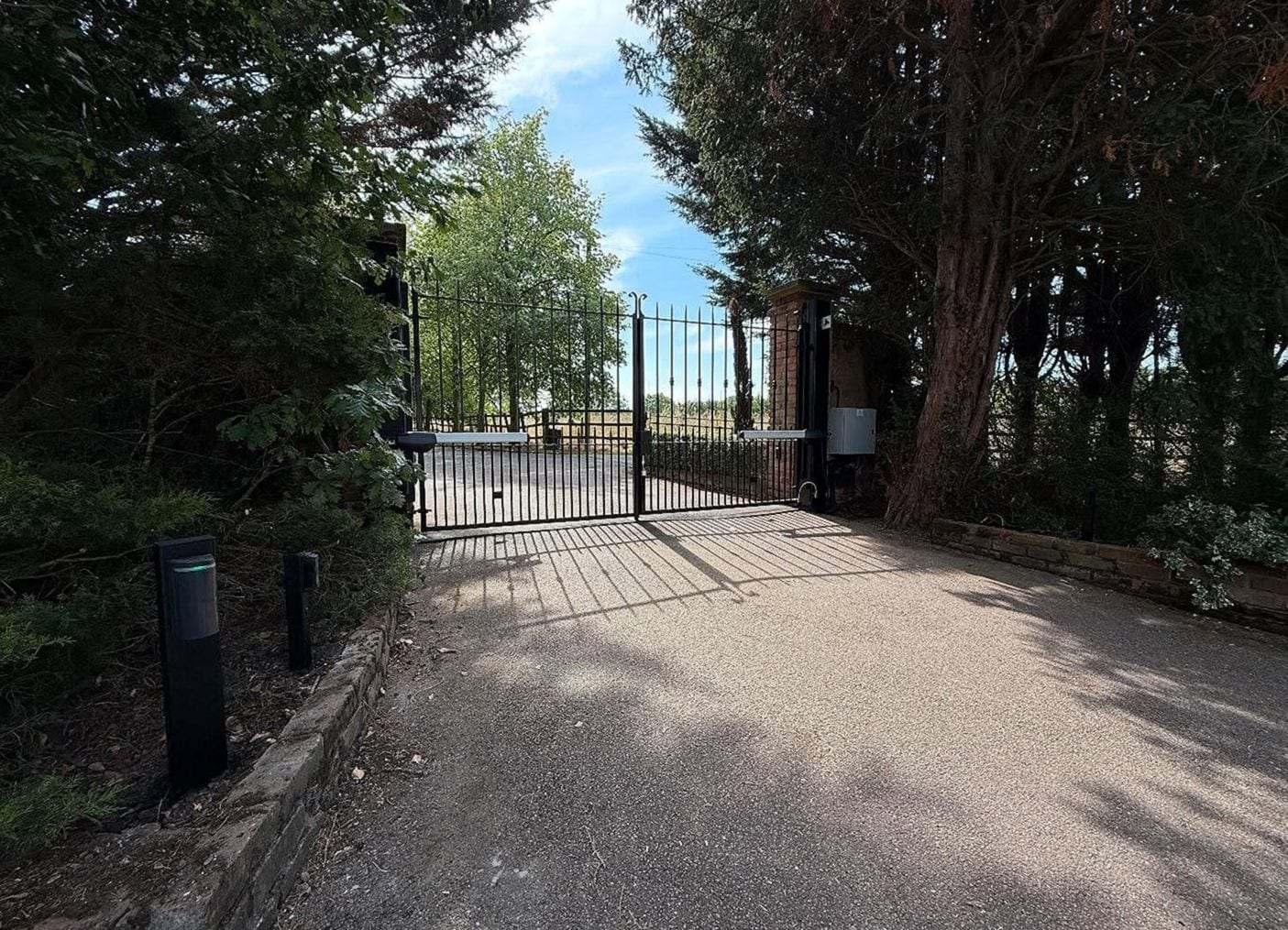
Should I choose a swing gate or a sliding gate?
A swing gate needs clear, fairly level ground for its leaves to open across. A sliding gate needs room along the fence line beside the opening. Where the drive slopes up behind the gate, or snow piles up where a gate would swing, a slider is often the better fit.
Can a gate go on a sloped driveway?
Yes, with planning. A swing gate on rising ground can hit the slope as it opens, so it may need to swing the other way or be hung higher. A sliding gate needs a level run for its track, or a cantilever design that keeps it off the ground.
What do I need to decide before planning a new gate?
How wide the opening is, which way the gate can open, who uses it and how, and whether it will be manual or automatic. If it will have an opener, think about where the power and the wiring for a keypad or sensors will run.
What does an automatic gate need at the post?
Power at the operator, a solid post or pad to mount it on, room for the photo eyes, and a path for the wiring to any keypad, intercom or loop, usually in conduit under the drive. Planning these before paving saves cutting it later.
Planning a new swing or sliding gate? Start with the gate installation page.
Access Control and Remotes
How many remotes can one opener learn?
It depends on the receiver. Many hold a set number, and the operator’s manual or the board says how many. Properties with lots of users often add a receiver with more room, or move to codes or cards.
My keypad stopped accepting the code. What should I check?
On a wireless keypad, the batteries first. Then make sure nobody has changed the code. If the keypad shows no light at all, or water or ice has got inside it, the keypad or its wiring needs looking at.
Can a gate intercom ring my cell phone?
Some can. Cellular and app-based intercoms call your phone when a visitor presses the button, and let you open the gate from it. They need a reliable cell signal or internet at the gate.
Can tenants or staff each have their own way in?
Yes. A keypad with several codes, a card or fob reader, or phone-app entry gives each person their own access, so one can be shut off without changing everyone else’s.
Where should a keypad go on the driveway?
Where a driver can reach it from the car window without getting out, far enough from the gate for the car to wait clear of it, and ideally off the street so nobody waits in traffic.
Keypads, intercoms, remotes and readers are compared on the access control page.
Maintenance and Winter Care
How often should someone look over my gate?
Give it a quick look yourself each season: hinges, wheels, the track and the photo eyes. Many owners also have it checked once a year, and the operator’s manual often gives its own service interval.
How should I deal with ice on a sliding gate track?
Shovel the track after each snow, chip ice away by hand, and ask whoever plows not to bank snow onto it. Do not run the opener against ice; the strain falls on the motor and the gears.
Should I grease the hinges, rollers and track?
Hinges and rollers with grease fittings, yes, as the maker suggests. A ground track is different: keep it clean and dry, because grease on the track holds grit and makes the wear worse.
Does road salt damage a gate?
Yes. Salt spray from the street speeds rust on steel, especially where the coating has chipped. Rinse the lower parts of the gate and posts in spring, and touch up chips before rust spreads.
How do I test the photo eyes?
While the gate is closing, set something like a cardboard box in its path, well clear of yourself. The gate should stop or reverse before it touches the box. If it does not, stop using the opener and call.
A season-by-season routine is in the gate maintenance guide.
Booking a Visit
Is there anything I should do before the visit?
Keep the gate, the opener and the control box easy to reach, put pets inside, and jot down what the gate does and when.
How do I get photos or a video of the gate to you?
Send the form first, since it takes text only. Then email the photos or a short video to office@madisondoorsgates.com, with your name and street in the email so we can match them to your request.
Can I book a visit for a rental property I do not live at?
Yes. We work with landlords and property managers as well as homeowners. Put the property’s ZIP code in the form, say where the gate is, and tell us who can let us in.
Do you come out to St. Clair Shores or Madison Heights?
Yes. We work in Warren, Center Line, Sterling Heights, Eastpointe, Roseville, St. Clair Shores, Fraser, Madison Heights and Hazel Park. If you are just outside those, ask.
Should I call or use the form?
Either works. Call if the gate is stuck open or closed and you want to talk it through. Use the form if you would rather write it down; we will be in touch to arrange a time to come take a look.
Ready to send a few words about your gate? Book a Visit.
Still have a question about your gate? Call us, or book a visit and we will set a time to come look.