
Gate Guides and a Plain Glossary
Practical guides for gate owners, and plain definitions of the parts we talk about.
Plenty of gate trouble shows early signs you can spot yourself, once you know what to look at. These guides cover three things every gate owner runs into sooner or later: a gate that will not open or close, the upkeep that keeps a gate moving year after year, and what to weigh when choosing a new gate. Each one is written for owners, not installers.
- Gate Troubleshooting GuideA gate that will not open or close: safe checks, likely causes and when to call.
- Gate Maintenance GuideA season-by-season routine for Michigan freeze-thaw, snow and road salt.
- Gate Buyer’s GuideGate styles, materials, operators and what moves the cost of a project.
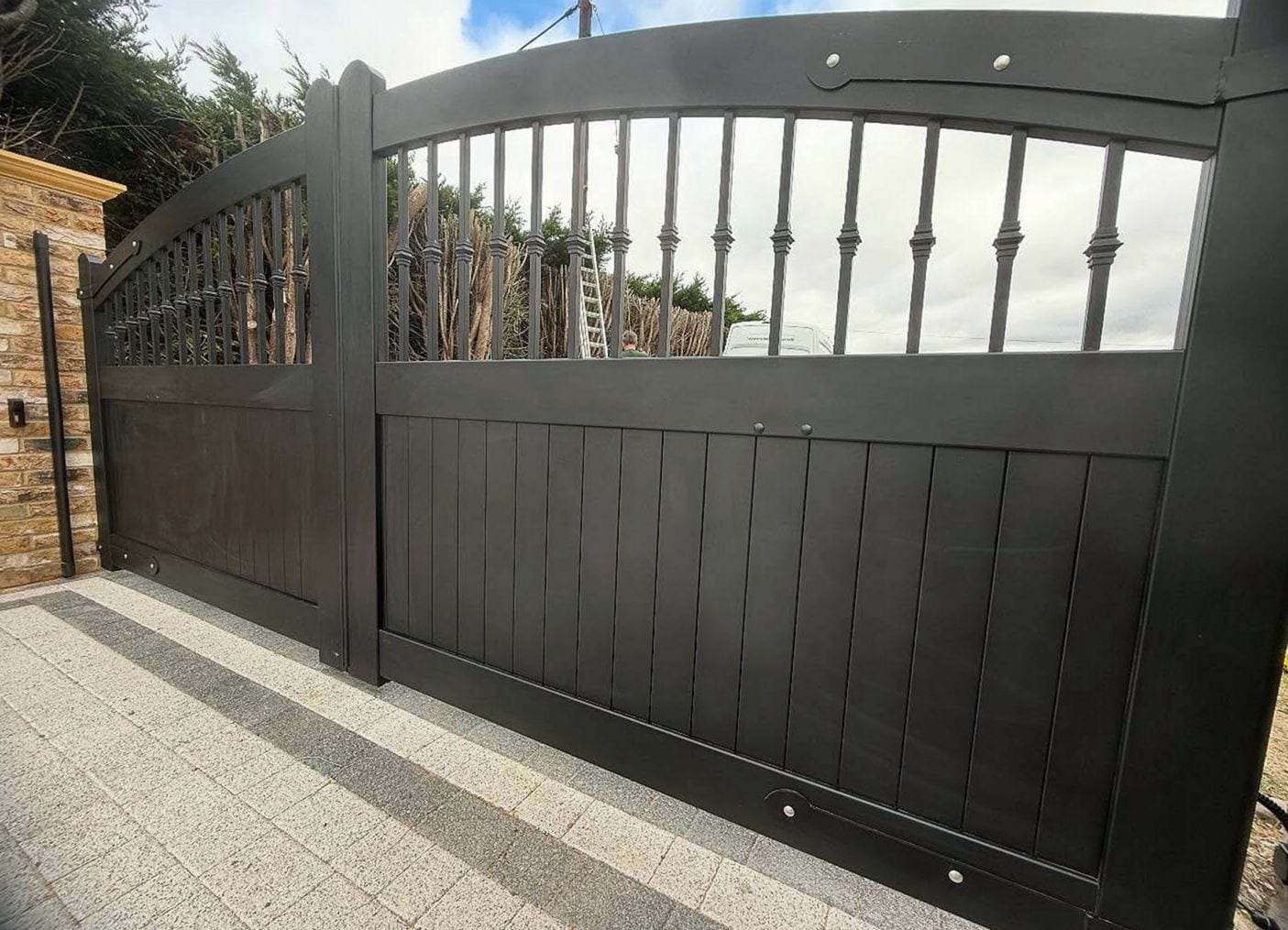
When a guide, a manual or a technician uses a word you do not know, look it up below. The glossary covers the parts of a gate and its opener, the safety devices, and the ways people get through.
Look Up a Gate Term
Type a word, or pick a category, then press the button.
Type a word or pick a category, then press Show Terms.
The Gate Glossary
Every term, grouped by the part of the gate it belongs to.
Gate Hardware
- Post
- The upright a gate hangs from or closes against, set in concrete. In clay soil, frost can lift a post out of line over a single winter.
- Hinge
- The pivot a swing gate turns on. A worn or loose hinge lets the gate sag and drag at the latch end.
- Gate latch
- The catch that holds a closed gate shut. When a gate sags, the latch stops lining up and will not catch.
- Gate stop
- A fixed block or post the gate closes or opens against, so it stops in the same place every time.
- Drop rod
- A sliding rod at the foot of a swing gate leaf that drops into a hole or sleeve in the ground to hold the leaf still.
- Track
- The rail a sliding gate rolls along, laid in or on the drive. Grit and debris in the track make the gate drag.
- V-groove wheel
- A wheel with a V-shaped groove that rides on an upturned V track and keeps a sliding gate on line.
- Guide roller
- Rollers at the post that hold a sliding gate upright as it moves. Worn ones let the gate wobble and rub.
- Cantilever gate
- A sliding gate carried on rollers mounted beside the opening, so no track crosses the drive. Handy where a ground track would fill with snow.
Openers and Controls
- Operator
- The motor unit that opens and closes an automatic gate. Swing gates and sliding gates use different kinds.
- Actuator
- A straight arm that pushes a swing gate open and pulls it closed, mounted between the post and the gate.
- Rack and pinion
- How most sliding gate operators move the gate: a toothed gear on the motor turns along a toothed strip fixed to the gate.
- Control board
- The circuit board inside the operator. It takes signals from remotes, keypads and sensors and tells the motor what to do.
- Limit switch
- The switch or setting that tells the operator where fully open and fully closed are, so the gate stops in the right place.
- Manual release
- A lever, key or knob that disconnects the gate from the motor, so you can move it by hand during a power cut or a fault.
- Battery backup
- A battery in or beside the operator that keeps the gate working for a limited number of cycles when the power goes out.
- Auto-close timer
- A setting that closes the gate by itself after it has stood open for a set time.
Safety Devices
- Photo eye
- A pair of sensors that send an invisible beam across the gate’s path. If something breaks the beam, the gate stops or reverses.
- Safety edge
- A rubber strip along the gate’s leading edge. When it presses against something, the gate stops or reverses.
- Obstruction sensing
- The operator’s built-in check on how hard the motor is working. If the gate meets more resistance than it should, it stops and reverses.
- Warning light
- A light on the post or the operator that flashes while the gate moves, so people nearby know to stay clear.
Access and Entry
- Keypad
- A number pad at the entrance that opens the gate when someone enters a valid code.
- Transmitter
- The handheld or visor remote that sends a radio signal to the operator. A weak battery is the usual reason its range drops.
- Receiver
- The radio part in or on the operator that picks up the remotes’ signals. Where its antenna sits affects the range.
- Intercom
- A call box at the gate that lets a visitor talk to someone inside, who can open the gate from there.
- Loop detector
- A wire loop set in the drive that senses a vehicle’s metal. It often opens the gate for cars leaving, or holds it open while a car is in the way.
- Card or fob reader
- A reader that opens the gate for a programmed card or key fob. A lost card can be shut off on its own.
When the Guides Do Not Answer It
Some problems do not fit a guide. The questions page collects what customers ask us most, grouped by topic.
If your gate is doing something none of these cover, call us or book a visit with a short description of the gate and what it is doing, and we will arrange a time to come take a look.
If a guide points to a part that needs a technician, call us and we will set a time to come look.